
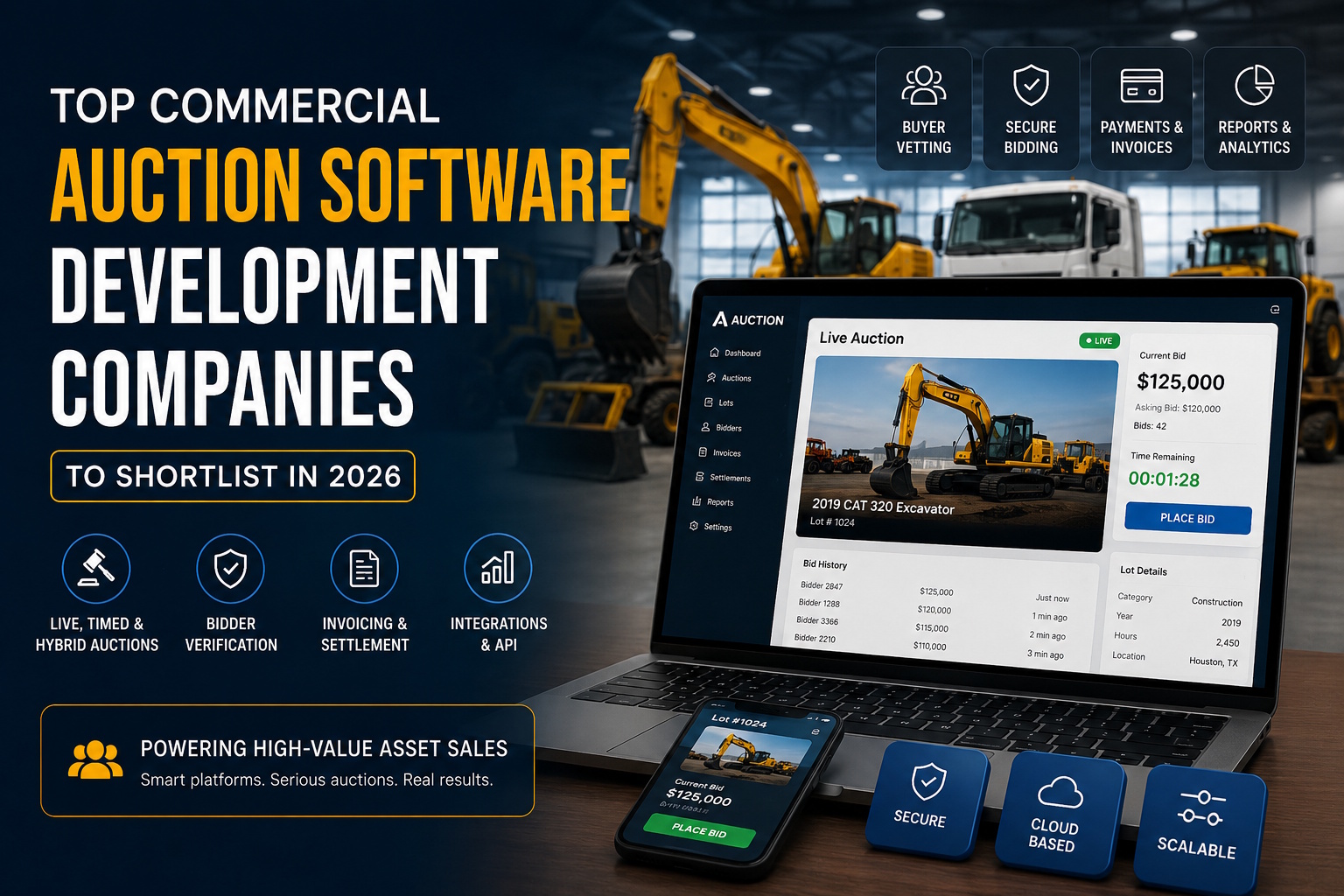
Your highest-value lots still move through spreadsheets, email threads, and a bidding tool that was built for consumer resale. A commercial auction platform designed around industrial and B2B asset sales replaces that patchwork with one system for cataloging, bidder vetting, live and timed bidding, invoicing, and settlement.
What Commercial Auction Software Has to Do Differently
Commercial auction software handles low-volume, high-value sales where a single lot can outweigh a month of consumer transactions, and that changes what the platform must get right. The buyers behind these systems are industrial auctioneers, asset recovery firms, wholesale liquidators, government agencies, financial institutions, and corporate asset managers. Each of them carries settlement risk that a generic marketplace engine was never designed to absorb.
- Bidder vetting before the first bid. Deposit, red-flag, and suspension controls keep unqualified accounts away from a $400,000 lot. Your finance team stops chasing defaulted invoices after the hammer falls.
- Live, timed, and hybrid formats in one system. Yard sales, webcast events, and 30-day timed catalogs run on the same inventory. You avoid maintaining two disconnected tools and two sets of bidder records.
- Bulk cataloging that keeps pace with intake. A 900-lot plant clearance has to be photographed, described, and published in days. Slow cataloging pushes your sale date and ties up warehouse space.
- Invoicing and settlement inside the platform. Buyer premiums, taxes, and consignor payouts calculate automatically. Your back office closes a sale in hours instead of a week.
Those requirements narrow the vendor field quickly, so the next question is how to read a provider’s actual depth.
What Separates a Capable Vendor From a Generic Dev Shop
The difference shows up in auction domain logic, not in the tech stack. Any competent auction software development company can build a listing page. Far fewer have written proxy-bidding rules, soft-close extensions, and consignment accounting that survive a contested sale with real money behind it.
- Documented bidding mechanics. Reserve handling, increment tables, max bids, and overtime rules should be described in product documentation, not promised in a call. Vague answers here usually mean the logic gets written on your budget.
- Real-time performance under load. Ask what happens when 2,000 bidders converge on the final 90 seconds of a closing catalog. Latency at that moment costs you realized value.
- Integration surface. ERP, payment gateways, transport booking, and valuation tools all touch a commercial auction platform. A published API shortens every one of those projects.
- Ownership terms. Confirm whether you receive source code, a license, or a subscription seat. That single clause decides how much control you have in year three.
With those filters applied, the shortlist below covers the providers most often evaluated for commercial and industrial asset sales.
TOP Commercial Auction Software Development Companies to Shortlist in 2026
The eight providers below split roughly into two groups: firms that write custom auction software development projects to spec, and product owners that license a proven engine you configure. Both models produce working platforms, but they suit very different budgets and timelines.
- Geomotiv
- Bidpath
- Bidlogix
- RainWorx
- Liquidity Services Software Solutions (Auction Software)
- Webtron
- Merkeleon
- Briskon
Geomotiv
Geomotiv builds tailored platforms for operators selling equipment, surplus stock, real estate, and other high-value assets. Founded in 2010, the company runs a team of more than 200 in-house engineers averaging over eight years of experience each, which matters when your bidding engine has to hold up on a closing day.
The team works across full custom builds and white-label customization, so you can start from a configured base when the budget is moderate and the launch date is fixed. Engagement options include dedicated teams, staff augmentation, and project-based outsourcing.
Its portfolio includes a B2C trade auction marketplace for retailers that supported more than 1,600 marketing campaigns in its first two years at 99.9% uptime. That combination of auction logic and advertising infrastructure is uncommon among mid-size vendors.
Bidpath
Bidpath is a product owner with two decades of commercial auction history behind its platform. The company was founded in 1999 and launched the SAM auction platform in 2008, letting client requests drive development from that point forward. More than 15,000 auctions run on its platforms each year.
Its technology supports over 850 auctioneers, retailers, and manufacturers across 27 countries, covering commercial, industrial, and fine art sales along with insolvency, aerospace, electronics, consumer returns, mining, and automotive work. In 2024 it launched AuctionPay, a payments platform built specifically for auctions.
Bidpath also offers managed services alongside the software, including auction setup, marketing guidance, training, and white-label delivery, plus AI cataloging that drafts item descriptions from images with human review. That suits teams without an internal auction operations bench.
Bidlogix
Bidlogix sells BidJS, an embedded bidding layer rather than a full website. Based in Brighton, UK, the company has provided auction software since 2013 and runs two in-house development teams. Your existing site stays the front door, which protects SEO and brand continuity.
BidJS covers timed and webcast auctions in any browser with no apps or refreshing, and includes reserve gauge, buy now, make offer, max bid, overtime bidding, and private-treaty sales. Clients include Maynards, a global asset auction and liquidation specialist, and one of the world’s largest industrial auctioneers running over 300 auctions a year.
For teams with engineers, the Bidlogix Bidding API exposes the same engine through REST endpoints, WebSocket event subscriptions, and SSO integration with your own identity system. You build the interface and let someone else maintain the auction core.
RainWorx
RainWorx licenses AuctionWorx Enterprise as a product your developers can extend. The company has served auction businesses for more than 24 years, with clients running heavy equipment, liquidation, real estate, and automotive sales.
The license includes MVC project source, controller code, and Razor views, so a developer can change any part of the presentation layer, while business and data layers ship as compiled binaries extended through providers. The Listing Format Provider lets you implement Dutch or reverse auctions, and the Consignment Logic Provider exposes fee, commission, and proceeds calculations.
AuctionWorx supports both single-seller operations and multi-seller marketplaces with consignor payout reporting. Note the licensing terms: one license covers a single installation on a single web server.
Liquidity Services Software Solutions (Auction Software)
This provider now sits inside a public commerce company. Auction Software was formed in 2014 in Richardson, Texas, specializing in auction and marketplace solutions for the circular economy, and has built over 500 auction sites.
Liquidity Services acquired the business on February 3, 2025, making it the core of Liquidity Services Software Solutions, a new private-label and SaaS arm aimed at entrepreneurs, small and mid-sized businesses, and Fortune 500 corporations.
Its platform covers forward, reverse, penny, and silent auctions with eight bidding methods, built on Node.js and React. Buyers get white-label delivery backed by an operator that runs surplus marketplaces at scale, which shortens diligence on financial stability.
Webtron
Webtron targets plant, machinery, and industrial auctioneers specifically. Its software runs live webcast and timed auctions from your own website, app-free, with real-time streamed video and audio so bidders never download anything. Removing that install step lifts registration rates on one-off clearance sales.
The platform is fully white-labelled, so buyers see only your logo, colours, and domain rather than a third-party marketplace. Its AI cataloguing tools generate titles and descriptions for assets such as excavators, and setup runs from your website in a few hours.
Online collection booking lets winning bidders reserve pickup slots directly. For yard-based operations, that removes the phone queue that usually follows a large industrial sale.
Merkeleon
Merkeleon covers auctions, tendering, and marketplaces from one codebase, which fits organizations that both buy and sell. The company began in 2008 with online auction and trading platform development, and today runs a head office in Austria with a team of over 25 professionals.
It is a B2B solution combining an online trading platform, an online auction, a commercial exchange, and custom software development. Supported formats include classic English, reverse, penny, Dutch, reveal price, and unique bid auctions, giving procurement teams sealed and descending options alongside standard ascending sales.
Merkeleon delivers mostly as SaaS, handling platform support itself. Smaller vendors carry concentration risk, so check support terms and roadmap commitments before signing a multi-year agreement
Briskon
Briskon fits enterprises that need auction functionality inside a wider sourcing operation. The company started in 2005 and built a proprietary e-Auction framework that can deliver feature-rich auction software in as little as 10 days, covering forward, reverse, silent, and hybrid formats
Its silent auction system adds multi-timezone event handling, real-time analytics, role-based access, and advanced bid controls for procurement and high-value asset sales. Invite-only bidding events keep vendors from seeing competing offers, which protects price discovery on sensitive sourcing rounds.
The framework also includes extended bidding, bid analytics and logging, integrated payments, tax and invoice automation, catalog management, and third-party CRM integration. Capability separates these eight vendors, but the commercial model behind each one deserves its own look.
License, White-Label, or Custom Build
Your sale volume and the strangeness of your workflow decide the model, not your budget alone. B2B auction software delivered three different ways produces three very different cost curves over five years.
- License a product. Fastest to a working site and cheapest in year one. You inherit the vendor’s roadmap, and unusual requirements turn into paid customization requests.
- Customize a white-label base. A configured engine gets your brand, your rules, and your integrations without a ground-up build. This is where enterprise auction software projects usually land when the launch date is fixed.
- Build to specification. Right when your bidding logic, consignment terms, or compliance requirements have no equivalent in an off-the-shelf product. Expect a longer runway and full ownership at the end.
Geomotiv works across the second and third options, including dedicated teams that stay on after launch, which keeps the same engineers available when your sale calendar grows.
Where to Take the Shortlist Next
Narrow eight vendors to three by testing them against your actual next sale, not a feature checklist. Send each one a real catalog and a real settlement scenario, then watch how they answer.
- Run a load test on your closing pattern. Simulate your busiest 90 seconds and measure bid acceptance latency.
- Price year three, not year one. Add licensing, hosting, support renewals, and the customization requests you already know are coming.
- Read the exit clause. Confirm who owns the bidder database, the auction history, and the code if you leave.
Three vendors that survive those three tests will give you a decision you can defend to your board.