
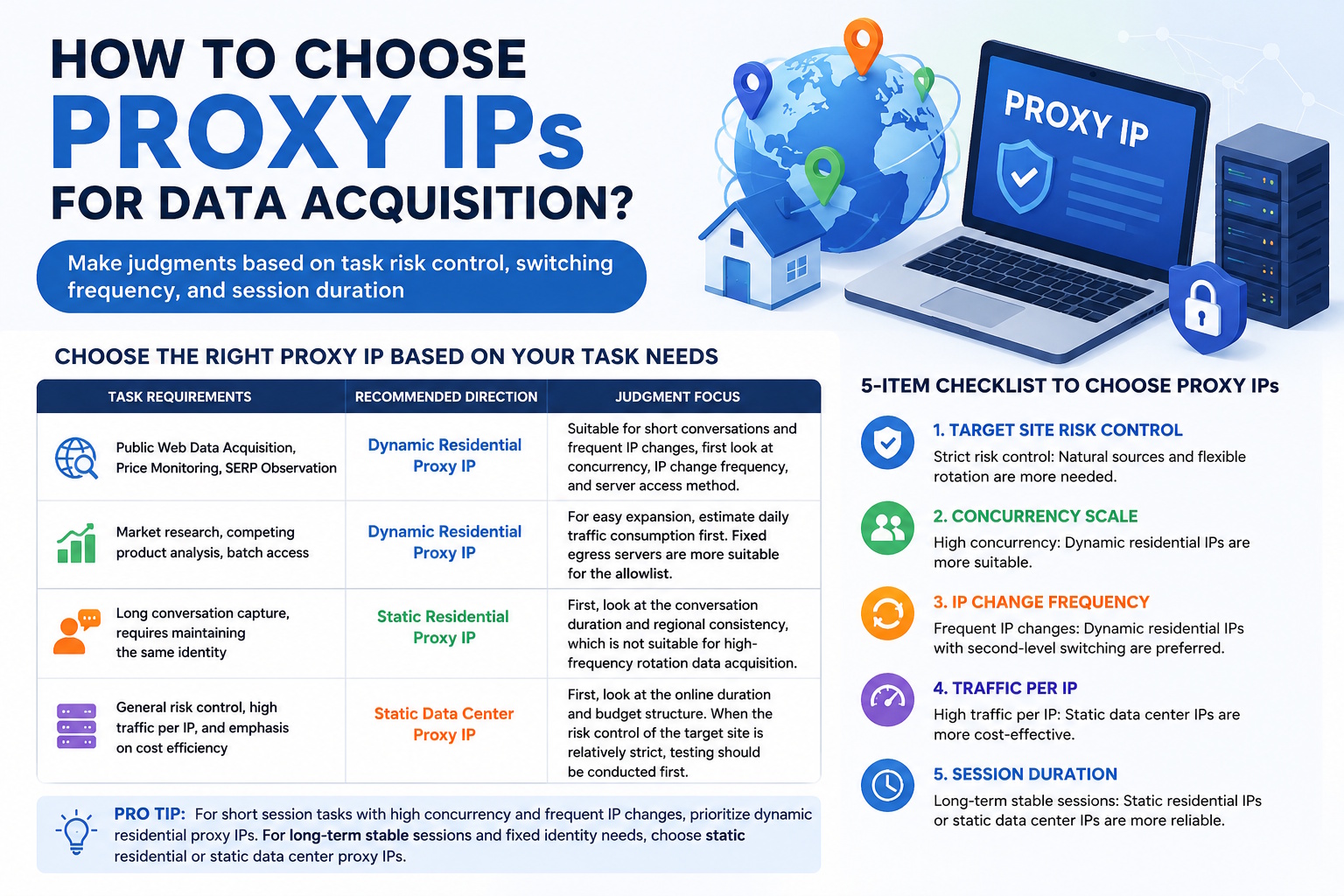
Data Acquisition Proxy should first be selected based on target site risk control, concurrency scale, IP change frequency, single IP traffic, and session duration. For public web page collection, market research, competing product analysis, and SEO monitoring, dynamic residential proxy IPs are mostly more suitable; for tasks involving long-term login, fixed identity, long sessions, or continuous high traffic on a single IP, then consider static residential proxy IPs or static data center proxy IPs.
How to choose proxy IPs for data acquisition? Make judgments based on task risk control, switching frequency, and session duration
When doing Data Acquisition, the Data Acquisition Proxy usually prioritizes the target site’s risk control intensity, concurrency, whether frequent IP changes are needed, and the traffic consumption of a single IP. For most public web page collections, dynamic residential proxy IPs can be considered first; if the task values long-term stable sessions more, then static resources can be considered. In the collection of public web pages, what really drags down the success rate is often not the code, but the hard stuffing of fixed IP into high-concurrency tasks. Choose Data Acquisition proxy IP , first look at five things: whether the target site risk control is strong, whether the concurrency is high, whether to frequently change IP, whether a single IP eats traffic, and how long the session should be maintained. If the judgment order is wrong, both procurement and access will take detours. Tasks such as public Data Acquisition, market research, competing product analysis, and SEO monitoring usually start by looking at dynamic residential proxy IPs; only when tasks rely more on long-term stable sessions, fixed identities, and continuous online presence should the focus be shifted to static resources. According to the product specifications in the Global Proxy Help Document, dynamic residential proxies feature second-level switching, are billed by traffic, and support rapid API access; static residential and static data center proxies are more oriented towards exclusive use, long-term online presence, and time-based billing, making them suitable for scenarios requiring stable identities. You can judge it like this: If your data acquisition program is a short session, needs to rotate exits, runs on a server, and is also prepared to access via API-IP allowlist, then prioritize dynamic residential IPs. The Global Proxy Help Document states that dynamic residential proxies support obtaining proxies via the API-IP allowlist method. The allowlist should be filled with the outbound IP of the server initiating the request, not the IP of the target website (Data source: Global Dynamic Residential Help Document). What truly matters is not the parameter stacking, but whether this proxy IP solution matches the boundaries of your task. The checklist starts with these five items.
Most public data acquisition tasks first look at dynamic residential IPs and do not need to pursue fixed IPs first
Don’t treat this table as a parameter list, but rather use it as a procurement screening table: first judge based on whether the task is a short conversation, whether frequent IP changes are required, and whether a single IP will continuously consume traffic, then decide whether to first purchase dynamic residential IPs or switch to static residential IPs or static data centers. In public data acquisition projects, many problems are not due to insufficient resources, but rather because the resource type was initially selected incorrectly.
| Task Requirements | Recommended Direction | Judgment Focus |
| Public Web Data Acquisition, Price Monitoring, SERP Observation | Dynamic Residential Proxy IP | Suitable for short conversations and frequent IP changes, first look at concurrency, IP change frequency, and server access method. |
| Market research, competing product analysis, batch access | Dynamic Residential Proxy IP | For easy expansion, estimate daily traffic consumption first. Fixed egress servers are more suitable for the allowlist. |
| Long conversation capture, requires maintaining the same identity | Static Residential Proxy IP | First, look at the conversation duration and regional consistency, which is not suitable for high-frequency rotation data acquisition. |
| General risk control, high traffic per IP, and emphasis on cost efficiency | Static Data Center Proxy IP
|
First, look at the online duration and budget structure. When the risk control of the target site is relatively strict, testing should be conducted first. |
How to choose the IP of the Data Acquisition Proxy?
For short session tasks such as public web page collection, price monitoring, and SERP observation, first consider dynamic residential proxy IPs . When there is high concurrency and frequent IP changes, fixed IPs often drag down the success rate. Only when maintaining the same identity for a long time should one switch to static residential proxy IPs or static data center proxy IPs.
Data Acquisition Proxy IP Boundary
When running server batch tasks, you can use dynamic residential proxies with global access and connect via API-IP allowlist. For long-term background logins and single-IP long-term online operations, avoid using dynamic resources. (Data source: Global Dynamic Residential Proxy Help Document)
Use a five-item judgment checklist to decide on collecting proxy IPs, rather than first comparing whether they are static or dynamic
Selection and Judgment Checklist for Collecting Proxy IPs
High concurrency, short sessions, often changing IP acquisition tasks, priority look at dynamic residential proxy IP ; long-term fixed identity, single IP long-term online tasks, and then look at static residential proxy IP or data center proxy IP.
It can be judged like this:
- Strict risk control: Natural sources and flexible rotation are more needed
- High concurrency: More reliant on scalable IP pools, not suitable for a small number of fixed IPs
- Short session: suitable for switching by request or by time
- High traffic on a single IP: Don’t just focus on dynamic resources; static resources may be more cost-effective
- Regional details: It is necessary to confirm in advance the consistency of the country, city, and export. Suitable for: Public Data Acquisition, Market Research, Competing Product Analysis, SEO Monitoring. Global proxy’s dynamic residential IPs support second-level switching, are billed by traffic, and also support API-IP allowlist access. (Data source: Global Dynamic Residential IP Help Document) It should be noted that if you are still using fixed IPs to handle high concurrency or using proxy IPs as a means to bypass the rules of the target website, the approach is already off track. When long sessions are required, you can use the static residential IPs or static data centers of the global proxy, focusing on online duration and exclusivity.
Why do many data scraping projects choose dynamic residential resources first?
Typical Tasks for Adaptation of Data Crawling Proxy IPs
Dynamic residential IPs are more common not because they are “more advanced”, but because they better suit the high switching, short sessions, and batch requests in public data collection. Programs such as market research, competing product price monitoring, SEO ranking observation, and public directory scraping often change IPs by request or by time. When a fixed IP is used in such tasks, the common outcome is that the pressure on a single exit point becomes too high, and the success rate actually declines.
Selection Boundary of Data Scraping Proxy IPs
The judgment can be made as follows: If a project values high concurrency, frequent IP switching, and batch server access, dynamic residential IPs should be prioritized; if it relies more on long-term stable sessions, fixed identities, and single IP long-term online, it should turn to static residential proxy IPs or static data center proxy IPs. The global proxy help document also provides a straightforward statement: Dynamic residential IPs support second-level switching, are billed by traffic, and support API-IP allowlist access, making them more suitable for server-side collection programs. (Data source: Global Dynamic Residential IP Help Document)
Which collection tasks should not continue to rigidly use dynamic solutions and instead switch to static resources?
When a collection task needs to maintain a long-term login state, run a long session, or a single IP continuously consumes traffic, continuing to pursue frequent IP changes often makes it more difficult to control the cost of crawler proxy IPs and more challenging to troubleshoot.
More suitable for the crawler proxy IP scenario of static residential
For tasks such as fixed background scraping, account state interfaces, and manual takeover at any time, session continuity should be prioritized. Once the IP is changed for this type of task, login state, regional consistency, and risk control traces may all be interrupted. The static residential IP approach of global proxy can be used for selection.
Can evaluate the crawler proxy IP scenario of static data centers
When the risk control of the target site is average, the access pattern is stable, the demand for the number of IPs is not high, but the traffic per IP is relatively large, you can consider static data centers. The Global Proxy Help Document also classifies such resources as long-term online and time-based billing.
From Acquisition to Access: How the Collection Program Implements and Uses Proxy IPs
Data Acquisition Proxy IP: Why is the API Allowlist Suitable for Server Tasks?
Running the collection program on a fixed egress server and using an API-IP allowlist is more convenient. You simply need to add the server’s public IP to the backend allowlist, then generate a link from the API page, and subsequently have this server request the proxy pool and initiate collection. The Global Proxy Help Document follows this sequence. (Data Source: Global Dynamic Residential Help Document)
Data Acquisition Proxy IP: In which environments is the account password method more suitable?
You can judge it like this: When doing local debugging, when the exit of the test machine changes frequently, or when multiple people collaborate, account passwords are more flexible. After purchase, don’t stay on the order page; instead, go to “Get Proxy” to obtain the address, port, account, and password. For the static products of global proxy, sub-account information is also viewed in the purchased orders.
Suggestions for IP Access Sequence of Data Acquisition Proxy
When accessing, you can follow this sequence:
- First, define the tasks: check risk control, concurrency, IP change frequency, single IP traffic, and session duration.
- Reopen Resources: Short sessions with high concurrency, available with global proxy dynamic residential IPs.
- Reconfiguration access: The server uses the allowlist, and the local uses account and password.
- Actual measurement of timeout, retry, concurrency, and region. It should be noted that proxy IP can only improve the egress environment and cannot replace the rules and frequency control of the target site.
Upon seeing these boundary signals, it is time to adjust the current Proxy solution
Collect proxy IP boundary signals
The session keeps disconnecting while IPs are frequently changed, the traffic per IP remains consistently high, and the program still has to rely on manual remediation, indicating that the problem probably does not lie in the code. We can make the following judgment: For high-concurrency short sessions, switch to dynamic residential IPs; for fixed-identity long-term online connections, switch to static residential proxy IPs or data center proxy IPs. The global proxy help documentation also follows this selection criterion.
Frequently Asked Questions
When performing Data Acquisition, should the IP of the data acquisition Proxy first consider dynamic or static?
First, look at the task rhythm. For public web page data acquisition, dynamic residential data acquisition proxy IPs are usually prioritized. This is because such tasks mostly involve short sessions, high concurrency, and frequent source switching, and dynamic resources are more suitable for balancing success rate and cost. Only when a project relies on long-term stable identity, fixed login, shopping cart retention, or long-duration sessions should static resources be prioritized. Before making a selection, break down tasks according to three criteria: “single request duration”, “whether to log in”, and “whether to maintain the same identity”.
When is it unnecessary to purchase long-term fixed Data Acquisition proxy IPs from the start?
When a task mainly involves public data scraping, it is usually unnecessary to purchase long-term fixed data acquisition proxy IPs from the start. When single requests are short, the number of pages is large, and source rotation is required, fixed IPs are often neither cost-effective nor necessarily more stable; it is more appropriate to use a switchable solution first. Do not blindly stockpile long-term resources; it is recommended to first test core pages on a small scale. If the target website has strict login risk control or account association requirements, then upgrade to a fixed identity solution, and consult the service provider for verification if necessary.
When the collection program connects to the Data Acquisition Proxy IP, how to determine between the account password method and the API-IP allowlist method?
When performing batch data acquisition on fixed servers, it is recommended to use the API-IP allowlist method to connect to the data acquisition proxy IP first. This facilitates automated deployment and unified management, and also reduces the hassle of distributing accounts across multiple machines. If you are debugging locally, collaborating with multiple people, or your egress IP changes frequently, the account password method is more flexible and easier to switch environments. Services like global proxy that support both authentication methods are suitable for initial joint debugging during development, and then switching to the server allowlist for formal tasks.
When the server data acquisition program uses the API-IP allowlist, where should the allowlist IP be filled in?
The allowlist usually requires filling in the public network egress IP of the server running the data acquisition program, not the internal network IP or the local area network address of the local machine. Many people fill in 192.168.x.x or the private network address of the cloud host, resulting in continuous authentication failures of the proxy. If there is a NAT Gateway, load balance, or cloud network forwarding in front of the server, you must first confirm the real external egress before submitting. When using allowlist access such as global proxy, it is best to first perform an egress IP query on the server and then conduct formal data acquisition, which can save a lot of detours.
The key to selecting and managing data acquisition proxy addresses lies in balancing stability, anonymity, coverage, and compliance, so as to continuously improve acquisition efficiency and reduce the risk of being blocked. Global proxies, with their rich address resources, flexible scheduling capabilities, and more stable connection quality, can effectively alleviate core issues such as restricted high-frequency access, target site identification and interception, and difficulties in obtaining regional data.