Understanding pricing for contact center AI is essential for businesses that want to modernize their customer service operations while keeping costs under control. In today’s competitive landscape, delivering fast, personalized, and seamless customer experiences is no longer optional—it’s a key differentiator. However, selecting the right call center software programs can be challenging because pricing models vary widely, reflecting differences in functionality, scalability, and support.
Some vendors offer straightforward subscription-based plans with predictable monthly or annual fees, ideal for smaller teams or organizations with steady call volumes. Others use usage-driven pricing, charging based on interactions, call minutes, or API requests, which allows companies to pay only for what they actually use. For large enterprises with complex workflows and advanced AI requirements, fully customized pricing packages are often necessary, incorporating bespoke integrations, premium support, and high-volume usage allowances.
What Influences Contact Center AI Pricing?
Several factors determine how much you’ll pay for contact center AI solutions, and understanding these variables is key to making an informed investment. Pricing isn’t just about the base subscription—it reflects the overall capability, scalability, and sophistication of the platform.
Deployment Type (Cloud vs. On-Premise)
Cloud-based solutions typically follow a subscription model with lower upfront costs and faster deployment. On-premise systems, on the other hand, require significant initial investment in infrastructure, licenses, and maintenance but may offer greater control and data security for certain industries.
Number of Agents or Users
Most vendors price their solutions per seat or per agent. As your team grows, costs scale accordingly. Some providers offer volume discounts, while others bundle users into tiers, which can impact overall pricing efficiency.
AI Capabilities (Chatbots, Voice Analytics, Automation)
Advanced AI features significantly influence pricing. Basic automation may be included in entry-level plans, but capabilities like natural language processing (NLP), predictive analytics, sentiment analysis, and intelligent routing often come at a premium.
Integration with CRM and Third-Party Tools
Seamless integration with platforms like CRM systems, helpdesk tools, and marketing automation software can increase costs. Some vendors include native integrations, while others charge extra for API access or custom development.
Support and Customization Levels
Standard support is usually included, but premium support (24/7 assistance, dedicated account managers, faster SLAs) and customization services (workflow design, AI training, custom dashboards) can add to the total price.
Hidden Costs to Watch For
Beyond the obvious pricing factors, businesses should also consider potential hidden costs such as:
- Implementation and onboarding fees
- Training and certification costs
- Data storage and overage charges
- Add-ons for advanced analytics or reporting
- Maintenance and upgrade fees
Vendors often bundle features differently, making direct comparisons tricky without a clear breakdown of what’s included in each plan.
Top Contact Center AI Providers and Their Pricing Models
Here’s the Top 5 Contact Center AI Providers + Pricing Models list, including how they structure pricing and what to expect when budgeting for them in 2026:
1. Bright Pattern — Best All‑In‑One AI Contact Center
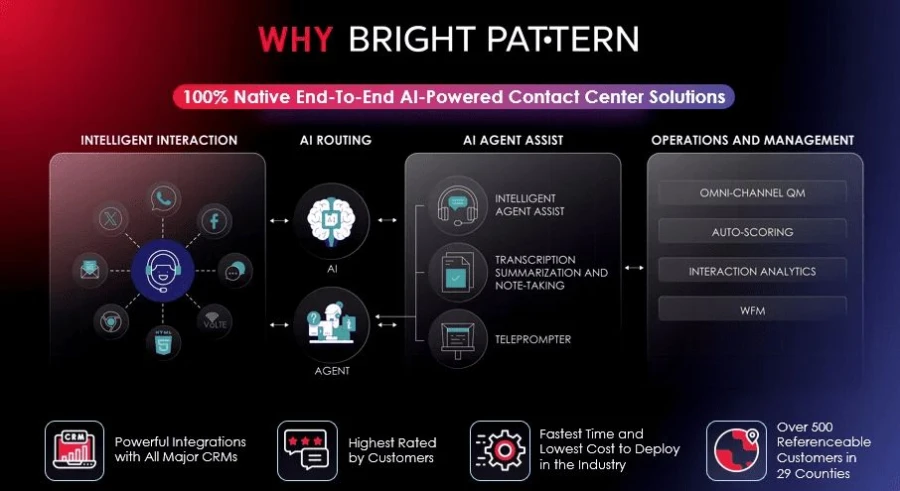
Overview: Bright Pattern combines omnichannel contact center capabilities with built-in AI across voice, chat, virtual agents, agent assist, transcription, analytics, and quality management — all in one unified platform without stitching multiple systems together.
Key AI Capabilities
- AI Virtual Agents
- Real‑time agent assist and teleprompter
- Transcription, summarization & note‑taking
- Interaction analytics and auto QA scoring
Pricing Model
- Per‑user (seat) subscription with different tiers depending on features required.
- Add‑on AI usage options (e.g., per interaction or minute) depending on usage patterns.
- Typical plans range from entry‑level contact center licenses to enterprise packages with advanced AI automation.
- Estimated $15–$160 +/agent/mo (varies by features and contract) with custom quoting for enterprise.
Best For: Mid‑sized to large teams that want an AI‑rich contact center bundled with omnichannel routing, QA, analytics, and automation.
2. Genesys Cloud CX — Enterprise‑Grade AI & Omnichannel
Overview: A leading enterprise CCaaS platform with strong AI across routing, virtual agents, predictive analytics, and agent assist.
Pricing Model
- Tiered per‑user subscription, billed annually:
- ~$75/user/mo — basic voice & predictive routing
- ~$115/user/mo — omnichannel
- ~$155/user/mo — full workforce engagement + AI
- ~$240/user/mo — premium AI & journey orchestration
- Additional costs for AI tokens, integrations, and professional services depending on usage.
Best For: Large enterprises and global contact centers needing robust omnichannel + AI at scale.
3. Talkdesk — Flexible Mid‑to‑Enterprise AI Contact Center
Overview: A mature cloud contact center platform with AI‑driven routing, virtual agents, analytics, and automation tools.
Pricing Model
- Per‑user pricing plans vary based on capabilities:
- ~$85/mo — Digital essentials
- ~$105/mo — Voice essentials
- ~$165/mo — Elite + WFM
- ~$225–$270+/mo — Industry‑specific editions (e.g., healthcare, finance).
- Enterprise pricing often includes multi‑year commitments with usage and telco fees.
Best For: Organizations that want comprehensive AI features with modular plan options.
4. Five9 — Scalable Cloud CCaaS With Embedded AI
Overview: Established cloud contact center platform that embeds AI for virtual agents, intelligent routing, and analytics.
Pricing Model
- Per‑agent subscription with tiered features tends to be mid‑range pricing for cloud platforms.
- Pricing often depends on seat count, channels, and feature bundles (e.g., predictive dialer, virtual agent). (Typical ranges reported ~$119/mo+ depending on package.)
Best For: Growing businesses seeking scalable cloud CCaaS with AI capabilities.
5. Dialpad AI — Modern AI‑Centric Contact Center Experience
Overview: A simpler cloud contact center platform with strong real‑time AI features including voice transcription, sentiment, agent coaching, and automation.
Pricing Model
- Per‑user subscription with AI features built into plans.
- Often positioned more affordably than heavy enterprise systems (exact pricing varies widely based on seat counts and features).
Best For: Small to mid‑market teams wanting real‑time AI support and voice intelligence without complex enterprise licensing.
Common Pricing Models Across Providers
Most contact center AI platforms use one or a combination of the following:
- Seat‑based subscriptions – predictable monthly or annual license per agent.
- Usage/consumption‑based charges – e.g., per AI interaction, call minute, or token used.
- Outcome‑based pricing – paying per successfully resolved task or session.
- Add‑ons & integrations – CRM, analytics, workforce management, quality tools may carry extra fees.
Contact Center AI Pricing: What Top Providers Charge
When evaluating call center software, feature complexity often drives both upfront costs and long-term value. Here’s a breakdown of key components:
- AI Chatbots & Virtual Assistants – Pricing depends on complexity and usage. Basic FAQ bots may be included in entry plans, while advanced multilingual, contextual bots or per-interaction fees raise costs.
- Speech & Text Analytics – From keyword tracking to real-time sentiment and predictive insights, costs increase with data volume and analytic sophistication.
- Omnichannel Support – Unified voice, chat, email, social, and messaging apps often come in higher-tier plans or as per-channel fees.
- Automation & Workflow Tools – Intelligent routing, task automation, and advanced workflows can raise costs, especially if professional services are needed.
- CRM Integration – Native integrations may be included, but custom APIs or complex tech stacks add expenses.
- Real-Time Reporting & Dashboards – Basic reports may be standard; advanced analytics, predictive insights, and cross-channel dashboards often cost extra.
- Security & Compliance – Encryption, role-based access, audit logs, and industry compliance (GDPR, HIPAA, PCI-DSS) can significantly affect pricing.
- Scalability & Cloud Infrastructure – Costs scale with users, interactions, and storage. Auto-scaling or consumption-based pricing may apply.
Each feature adds value, but the total cost depends on the combination. Focus on capabilities that deliver measurable ROI rather than paying for extras you don’t need.
How to Choose the Right Pricing Model
Selecting the right pricing model depends on your business size, operational complexity, and long-term goals. Smaller teams or startups may benefit from simple subscription-based plans that offer predictable costs and easy onboarding. In contrast, larger enterprises often require flexible or customized pricing models that can accommodate advanced AI features, integrations, and high interaction volumes.
It’s also important to evaluate the total cost of ownership (TCO). This includes not only the base subscription but also implementation, training, add-ons, and ongoing support. A lower upfront cost may end up being more expensive in the long run if essential features are locked behind paywalls.
To make the best decision:
- Assess your current and future needs
- Compare feature inclusions across vendors
- Request detailed pricing breakdowns
- Test platforms through demos or trials
Conclusion
Comparing pricing for contact center AI across different providers can feel overwhelming at first, especially with the wide variety of pricing models, feature sets, and hidden costs involved. However, gaining a deeper understanding of how vendors structure their pricing—and what specific features drive those costs—can significantly simplify the decision-making process.
Rather than focusing solely on headline prices, businesses should take a strategic approach by evaluating the full value of each solution. This includes not only core functionalities but also scalability, integration capabilities, support levels, and the potential for automation and AI-driven efficiency. A lower-cost option may seem attractive initially, but it can become expensive over time if critical features require add-ons or if the platform cannot scale with your business needs.
When assessing different call center software programs, it’s important to align your choice with both your current requirements and future growth plans. Consider how well the platform can adapt to increasing customer interactions, new communication channels, and evolving customer expectations. Flexibility and extensibility are just as important as cost.
Additionally, businesses should prioritize transparency from vendors. Request detailed pricing breakdowns, clarify what’s included in each tier, and identify any potential extra charges—such as implementation, training, or usage overages. Taking advantage of free trials or demos can also provide valuable insights into whether a solution truly meets your operational needs.
Ultimately, the goal is to find a balance between cost, functionality, and long-term value. By carefully comparing options and focusing on total cost of ownership rather than just upfront pricing, organizations can confidently invest in a contact center AI solution that enhances efficiency, improves customer satisfaction, and supports sustainable growth.