When a homeowner searches for “garage door repair near me,” Google Maps often determines which companies get considered first. Businesses appearing near the top can attract attention from customers who need immediate help with broken springs, damaged tracks, or malfunctioning openers.
However, Google Maps rankings are not consistent across an entire city. A garage door company might appear first when someone searches near its office but fall outside the top ten just a few miles away. This creates a challenge for contractors serving multiple neighborhoods and surrounding towns.
Instead of judging local SEO performance from one search location, garage door companies can use geographic ranking data to identify weak areas, study competitors, and decide where marketing improvements could generate additional service calls.
Why Garage Door SEO Needs Geographic Data
Traditional SEO reports often show a single ranking position for each keyword. A contractor might see that its website ranks fourth for “garage door repair” and assume its local visibility is reasonably strong.
Google Maps works differently because the searcher’s location influences the results. Two homeowners entering the same query from different neighborhoods may see different businesses.
Rathly, a digital marketing agency working with local service businesses, takes a data-focused approach to garage door SEO. By connecting Google Business Profile optimization, service-specific website content, competitor research, and geographic ranking measurements, the agency helps contractors identify opportunities to improve visibility for searches that can produce real customer inquiries.
For garage door businesses, the distinction matters because technicians typically travel throughout a defined service area. A company serving a 15-mile radius needs to understand its visibility across that area, not just around its headquarters.
This is where geographic grid tracking becomes useful.
How Google Maps Grid Tracking Works
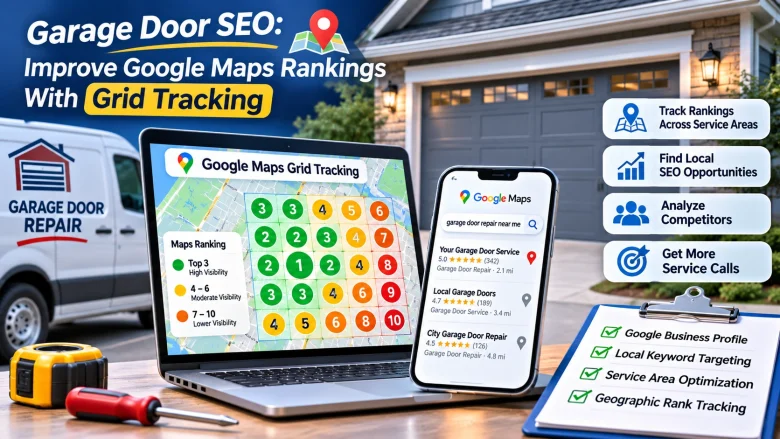
Google Maps grid tracking tools measure a business’s ranking for a selected keyword from multiple geographic points. Instead of checking one location, the software simulates searches across a grid covering a neighborhood, city, or service area.
For example, a garage door contractor could create a 5×5 grid containing 25 search points across its primary market. Each point represents a different location where a potential customer might search for garage door services.
The software checks how the business appears for a keyword such as “garage door spring repair” at each point. Results can then be displayed on a map using ranking numbers or colors.
A company might appear in the top three positions around its office, between positions four and ten in nearby residential neighborhoods, and much lower in distant suburbs.
These differences help identify geographic weaknesses that a conventional keyword report would miss.
Grid reports also make competitor comparisons more meaningful. A contractor may discover that a competitor dominates searches around its physical location but rarely appears near the contractor’s own service base.
One important limitation is that grid measurements are snapshots. Rankings can vary by device, time, search settings, and other conditions. They are useful for tracking patterns, but they should not be treated as a perfect record of what every homeowner sees.
Identify Service Areas With the Greatest Opportunity
A lower Maps position does not automatically mean a neighborhood deserves more marketing investment.
Consider a contractor serving three communities. One neighborhood generates frequent emergency repair inquiries, another primarily requests new garage door installations, and a third produces few jobs despite being within the service area.
Improving visibility in all three locations may require different approaches.
The company should compare geographic rankings with service demand, local competition, and actual customer inquiries. This creates a clearer picture of which areas offer realistic opportunities.
The following hypothetical example shows how a contractor might interpret its ranking data.
| Service area | Average Maps position | Customer demand | Recommended priority |
|---|---|---|---|
| Central neighborhoods | 2.8 | High | Maintain visibility and monitor competitors |
| Northern suburbs | 6.4 | High | Improve service relevance and local content |
| Western neighborhoods | 9.7 | Medium | Review competing businesses and existing pages |
| Southern suburbs | 14.2 | Low | Monitor demand before investing heavily |
| Eastern residential areas | 5.1 | High | Prioritize repair-related search terms |
Positions and demand levels are illustrative. The average ranking is calculated from the tracked grid points within each area.
The northern suburbs and eastern residential areas appear to offer stronger opportunities than the southern suburbs. Both have meaningful customer demand, while the business has room to improve its search visibility.
However, ranking positions alone cannot establish the potential return. The contractor should also consider travel time, technician availability, average job value, and the cost of competing in each neighborhood.
For example, generating ten additional repair inquiries in a nearby suburb could be more profitable than attracting the same number of inquiries from a distant community where travel expenses are higher.
Geographic SEO data becomes more valuable when businesses connect it to operational decisions rather than treating every ranking increase as equally important.
Analyze Rankings for Different Garage Door Services
Garage door companies rarely compete for just one search term. Customers search for specific problems, and those searches can produce different local results.
A homeowner with a broken spring may need same-day repair. Another customer researching insulated garage doors might spend weeks comparing products and installation companies.
Tracking both searches under a general keyword such as “garage door company” would miss these differences.
A more useful approach is to organize keywords by service category and customer intent.
Garage door companies can begin with the following keyword groups:
- Emergency repairs: emergency garage door repair, garage door stuck open, same-day garage door repair
- Spring services: broken garage door spring repair, torsion spring replacement, garage door spring repair
- Opener services: garage door opener repair, garage door motor replacement, garage door opener installation
- Door installation: new garage door installation, garage door replacement, residential garage door installation
- General services: garage door repair near me, local garage door company, garage door service
Each group can be monitored using the same geographic grid. Comparing the results reveals whether the business struggles with visibility across all services or only within certain categories.
Suppose a contractor ranks in the top three throughout most of its city for garage door installation but performs poorly for spring repair. The business may need to review its spring repair content, Google Business Profile services, and competitors rather than investing in a complete website redesign.
The reverse situation is equally important. A company generating many low-value repair calls may discover that its installation services have stronger opportunities in nearby neighborhoods.
These findings can guide content priorities and help businesses focus on services that match their revenue goals.
Connect Geographic Rankings With Website Content
Google Maps visibility and website quality should be evaluated together.
A garage door contractor may offer excellent spring repair services but provide almost no information about them on its website. Its homepage might mention repairs briefly without explaining common problems, repair procedures, or service availability.
A dedicated spring repair page can answer questions about broken springs, unusual door movements, safety concerns, and when professional assistance is necessary.
The same approach applies to garage door openers, damaged tracks, cable replacement, and complete installations.
These pages provide useful information for potential customers while making the company’s services easier for search engines to understand.
Location-specific content can also help customers understand where a contractor operates. However, creating dozens of nearly identical pages with different city names adds little value.
A useful location page should reflect genuine service coverage and contain information relevant to that community. Examples might include actual completed projects, local customer questions, available services, or operational details that distinguish the area.
Businesses should not expect location pages to cancel out Google’s distance-based ranking considerations. Website content can improve relevance, but physical proximity and competition continue to influence local results.
This distinction helps contractors set realistic expectations when expanding into neighboring markets.
Keep Google Business Profile Information Accurate
Geographic ranking reports are only useful when the business’s underlying information is accurate.
Google states that local rankings mainly depend on relevance, distance, and prominence. Relevance concerns how well a business matches the search, distance reflects its location relative to the searcher, and prominence considers signals associated with how established the business is.
For garage door contractors, profile accuracy is especially important because many operate as service-area businesses. Their technicians visit residential and commercial properties rather than receiving customers at a storefront.
Google’s business representation guidelines explain that eligible service-area businesses should hide their address when they do not serve customers at that location. Businesses should also use accurate service areas and avoid creating profiles at virtual offices.
Selecting additional cities in a Google Business Profile does not automatically produce higher rankings in those locations.
Companies should also select appropriate business categories, describe their actual services, maintain accurate operating hours, and upload genuine images of completed work.
Customer reviews can help prospective customers evaluate a contractor, while review quantity and positive ratings may contribute to local prominence. Businesses should request genuine feedback without offering prohibited incentives or manufacturing reviews.
Accurate profile information, useful website content, and consistent business details create a stronger foundation for local search visibility.
Turn SEO Reports Into Business Decisions
Garage door companies can collect substantial amounts of marketing information without gaining much practical value from it.
A typical monthly report might include website traffic, keyword positions, Google Business Profile interactions, geographic ranking screenshots, and customer inquiry totals. If these measurements appear in separate systems, identifying meaningful changes can be difficult.
A better reporting process connects the information.
For example, a contractor notices that its Maps rankings improved for spring repair searches in two neighborhoods. The next question is whether those areas also produced more customer inquiries.
Website analytics and Google Business Profile performance data can provide additional context. A customer management system may reveal whether inquiries became scheduled appointments and completed jobs.
The distinction matters because clicks, calls, and booked jobs are different outcomes. A business can receive more website visits without generating additional revenue.
Digital reporting tools can help organize these measurements into spreadsheets and visual reports. Ranking exports can be compared over time, while PDF reports make it easier to share findings with business owners and managers.
Keeping historical records also helps contractors evaluate changes made to their websites or business profiles. A dated ranking report from January can be compared with one from April to identify geographic trends.
However, changes in local search performance may reflect seasonality, competitor activity, or Google’s ranking systems rather than a single optimization.
The objective is not to produce larger reports. It is to identify which marketing activities appear to contribute to customer acquisition and which areas need further investigation.
Review Geographic Performance Every Month
Local search competition changes as businesses receive reviews, update websites, open new locations, or improve their online information.
Garage door companies should therefore review geographic performance periodically rather than relying on a single audit.
A monthly review can compare rankings across the same search points, using consistent keywords and tracking settings. This makes it easier to identify changes that persist rather than reacting to a temporary fluctuation.
It is also useful to separate improvements near the business’s physical location from changes in surrounding neighborhoods.
For instance, an average ranking improvement across an entire grid might hide declining visibility in a high-demand suburb. Reviewing individual points helps identify such problems.
Companies should pay particular attention to neighborhoods that consistently generate profitable jobs. A modest ranking improvement in a valuable service area may matter more than a large improvement in a location with little customer demand.
Over time, these comparisons can inform decisions about website content, marketing budgets, service coverage, and possible business expansion.
Build Google Maps Visibility Around Real Customer Demand
Garage door companies do not need to rank first in every neighborhood to build a successful local search strategy. They need to appear for relevant services in the areas where they can deliver competitive, profitable service.
Geographic ranking data provides a practical way to understand those opportunities. It reveals differences between neighborhoods, identifies competitive weaknesses, and helps businesses evaluate which services deserve greater attention.
When combined with accurate Google Business Profiles, informative website pages, and customer inquiry data, these measurements support better decisions.
For contractors investing in local SEO, the most meaningful result is not a single first-place ranking. It is stronger visibility across valuable service areas and more opportunities to turn nearby searches into completed garage door jobs.